




At a glance
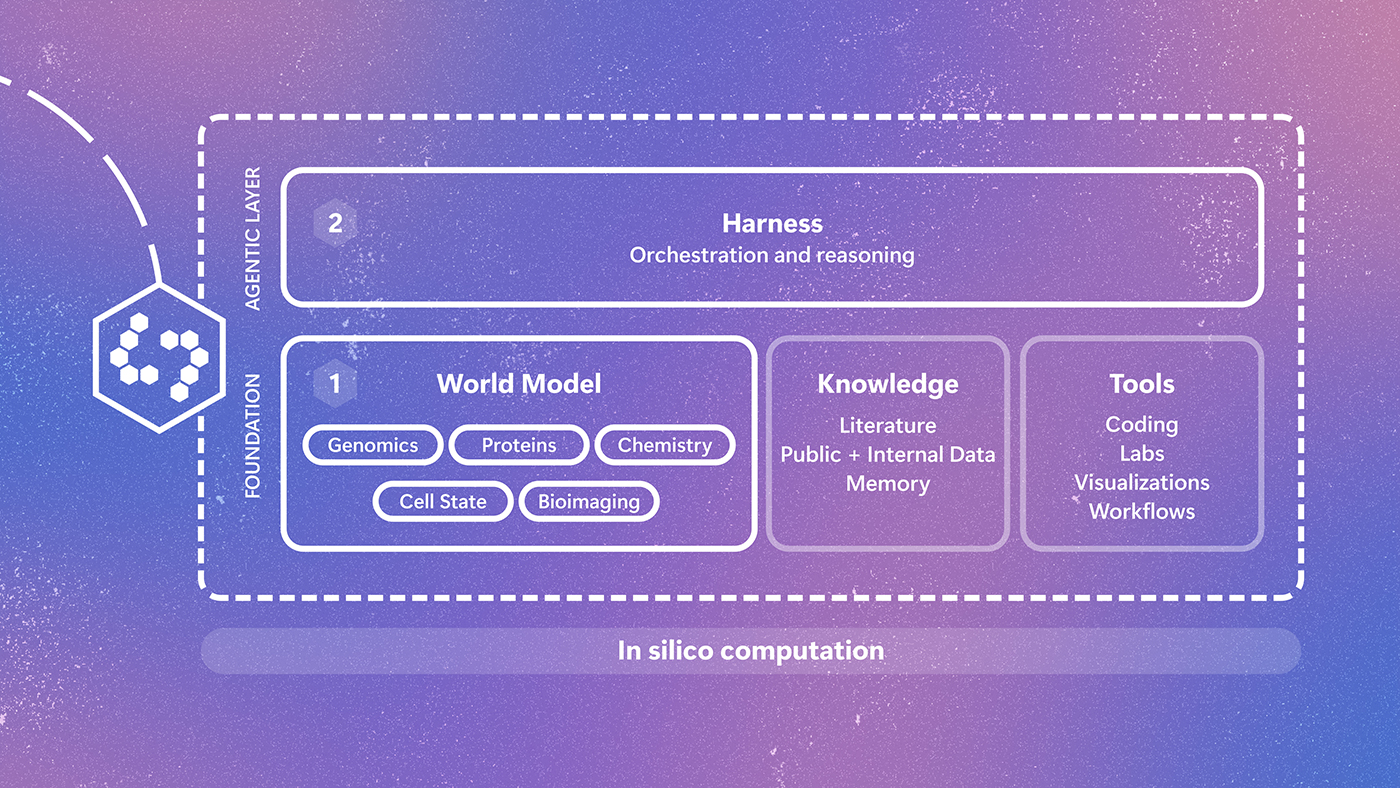
- Quine (opens in new tab) is a research effort to create a multimodal world model of biology and an interactive harness connecting models, scientific tools, literature, and researchers.
- In collaboration with researchers at the Broad Institute of Harvard and MIT, we have used this system to prioritize compounds predicted to drive therapeutic tumor-state shifts and validated several top-ranked candidates across multiple wet-lab assays.
- The Quine Fellows program (opens in new tab) will give a cohort of scientists access to the system and an opportunity to accelerate their own research and provide scientific feedback.
- Quine is experimental research technology intended only for research, not clinical or medical use, and its outputs may be incomplete or inaccurate and require review by qualified researchers and appropriate scientific and experimental validation. As the technology matures, we expect to expand access through products like Microsoft Discovery (opens in new tab).
For more than two decades, Microsoft Research has worked at the intersection of computation and biology. Our research has spanned immunology, virology, genomics, biomedical imaging, cell biology, and protein engineering. That work has produced foundational methods, new science, and technology that reached the clinic, from rare and infectious disease diagnosis to cancer biomarker detection.
Across that work, one lesson has become increasingly clear: biology does not divide itself into the neat boundaries our models and tools often do. Genes influence proteins; proteins interact within cells; cells organize into tissues; and experiments continually reshape what scientists know and what they choose to ask next. Making progress on the hardest biological questions therefore requires more than increasingly capable models of individual datasets or tasks. It requires systems that can connect knowledge across scale and modalities, reason about experiments and evidence, and participate in the iterative process through which science advances.
Today, Microsoft Research is introducing Quine (opens in new tab), a research effort designed to work across those boundaries, reflecting our long-term vision for a discovery system that evolves through scientific use. Quine brings together a world model of biology with a harness that connects scientific tools, literature, the wet lab, and the researchers using them.
The limits of experimentation
Even as experimental techniques have improved and wet-lab throughput has increased, biology remains fundamentally constrained by time and complexity. Nature cannot be rushed, nor can it be derived from first principles. Experiments are slow, iteration cycles are long, and many of the most important questions involve interactions, combinatorial design spaces, and downstream effects that are simply too large to explore experimentally alone.
At the same time, advances in large-scale machine learning, particularly the emergence of general-purpose foundation models and reasoning models that can iteratively work through problems, suggest a new possibility. These systems are beginning to demonstrate capabilities beyond pattern recognition: integrating information across domains, reasoning over abstractions, and supporting iterative problem-solving. Just as importantly, many of the techniques developed for human language have proven remarkably adaptable to aspects of biology, enabling models to learn representations of biological systems across diverse data types and scales.